Toshiba Satellite R10 Reviews
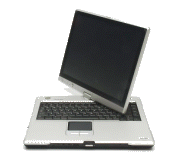 The Toshiba Satellite R10 is a perfect option for notebook users who would like to move beyond the keyboard and take notes, handwrite an e-mail or draw with digital ink on a portable, fully configured notebook PC. It is designed to offer dual functionality – a convertible notebook that allows users to work with a traditional keyboard, or a Tablet PC with digital pen-based input and control, once the LCD screen has been rotated and folded on top of the keyboard. The Satellite R10 laptop / tablet from Toshiba features a 14.1-inch XGA display that offers a large writing and viewing area, simulating the dimensions of a paper notepad.
Short Toshiba Satellite R10 Specifications:
Intel® Centrino[TM] Mobile Technology supporting Intel® Pentium® M processor 725 (1.60GHz, 400MHz, 2MB 2nd Level cache)
Intel® PRO Wireless Network Connection 802.11 b/g
Intel® 855GME integrated graphics solution w/ Intel® Extreme Graphics 2 technology
14.1″ XGA TFT display (1024 x 768)
256MB DDR RAM (expandable to 2048MB)
40GB hard disk drive
Slim SelectBay CD-RW/VD-ROM combo drive
Integrated 56Kbps modem, 10/100 Ethernet LAN, i.LINK (IEEE 1394) port, 3 x USB 2.0×3, 1 x PC Card slot, 1 SD card slot, RGB
328 x 289.7 x 36.9 (front)/38.4 (back) mm
2.58kg (with standard battery and weight saver) 2.78kg (with standard battery and optical disk drive)
Toshiba Satellite R10 features Toshiba EasyGuard: Password Utilities, Shock Protection Design, Magnesium Casework, HDD Protection, PC Diagnostic Tool, Cable Lock, Toshiba ConfigFree[TM] connectivity software, Diversity Antenna Technology
Toshiba Satellite R10 Reviews
Here are some reviews of this new tablet PC from Toshiba:
CNET Reviews Asia reviewed the Toshiba Satellite R10 (Pentium M Processor 725 1.6GHz, 256MB RAM) and stated:
Toshiba’s R10 Tablet offers consumers a chance to bite at the tablet PC concept. While it’s an acceptable notebook in its own right, the tablet features won’t go far enough for most to make it a worthwhile purchase.
Like the rest of Toshiba’s tablet PC designs, the Satellite R10 tablet is a convertible tablet, which means that in its standard form it’s virtually indistinguishable from a regular notebook. As a tablet, the other important design aspect of the R10 is the stylus, which can be found in a socket on the right hand side of the tablet. Using the same technology that’s behind Wacom’s Graphire writing tablets, the pen needs no power source and is remarkably accurate at picking up user pen strokes – although whether users are any good with tablets is another matter that we’ll touch on shortly.
…
New Tablet users, especially if you’ve never used a graphics tablet will probably find the experience of using a plastic pen on a plastic screen to be quite an unusual one, but once the newness has worn off you’ll realise that the hype about “writing” with it is just hype, as it’s nothing like writing on paper at all. A little patience will improve your methodology, but it’s still an approximation at best. Likewise, the much vaunted handwriting recognition technology may be amazing conceptually, but in our real world testing we’ve always been able to find more than a few people able to confuse the software beyond help with just a few errant pen strokes.
The Sydney Morning Herald has also a Toshiba Satellite R10 review:
‘But tablet PCs are yet to redeem themselves in the eyes of users and Toshiba’s Satellite R10 tablet pc is a good example of why. The Satellite R10 has a 14.1 inch, 1024×768 display supported by integrated graphics. Under the bonnet is a 1.7 GHz Pentium M processor with 512 MB of RAM, a +/-/RAM dual layer DVD burner and a 60 GB hard drive. Ports include one FireWire, three USB2.0, a SD card slot and a PC card slot, along with VGA and s-video out. Other features include a 56K modem, 10/100 Ethernet and 802.11 a/b/g wireless.
An optional tablet multi-dock allows for easy connection to peripherals while at home or in the office. This makes the R10 an excellent $2500 notebook, but unfortunately it costs $3500. That $1000 premium buys you the ability to fold the keyboard under the monitor to create a tablet PC, using a stylus and handwriting recognition to enter text. If you are not going to regularly use it this way, you are simply wasting $1000. The R10 can be rested on the arm like a clipboard but it weighs in at 2.8 kilograms – much heavier than Toshiba’s previous tablet PCs. Even Moses would have struggled with one of these tablets on each arm.’


